


How to Choose the Right Dental Composite for Different Restorations
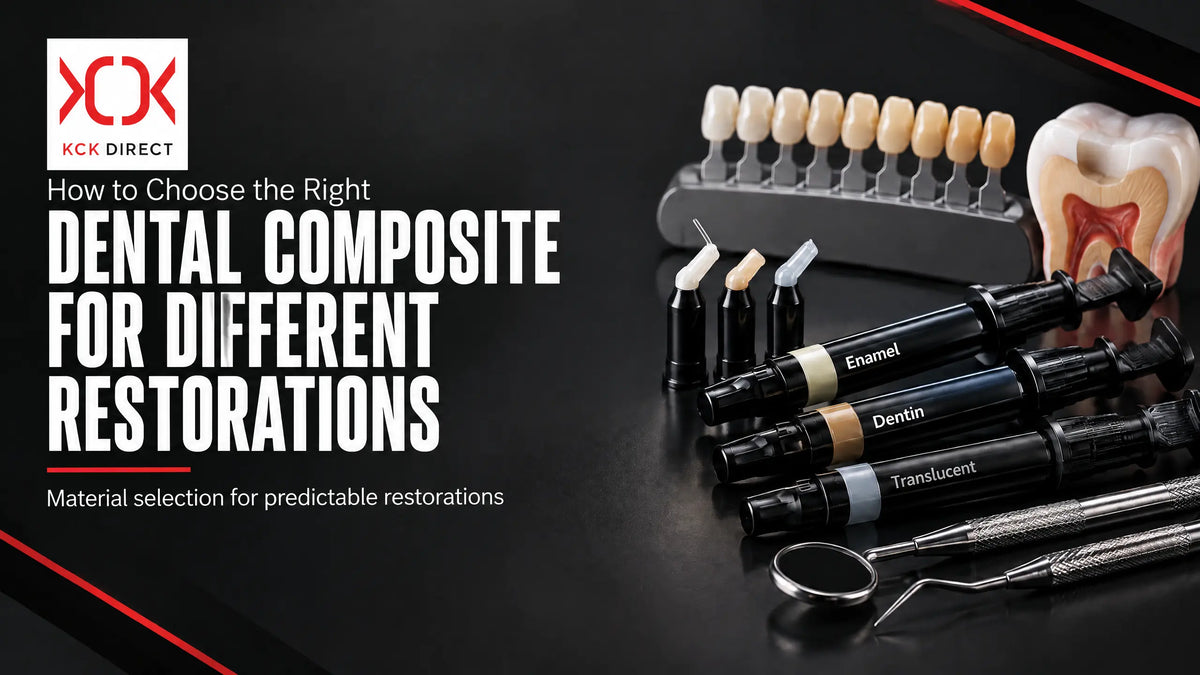
Choosing the right dental composite means matching the material to the specific restoration. Dentists need to consider factors such as the location of the restoration, cavity size, functional stress, aesthetic needs, handling, viscosity, optical properties, and curing requirements.
But how do you know which composite is right for each case?
In this guide, our dentist explains the key factors to consider when choosing a dental composite.
You will learn which composites are suitable for anterior and posterior restorations, when to use flowable and bulk-fill composites, and how to select a material based on the clinical situation.
This guide covers the essential points dental students need to know when choosing the right composite for different restorations.
What Factors Should You Consider When Choosing a Dental Composite?
Choosing the right dental composite depends on the type of restoration. Consider the following factors before selecting a material.
Location of the Restoration
First, consider where you will place the restoration. Anterior restorations need good aesthetics and natural-looking results. Posterior restorations need good strength and wear resistance. Choose a composite that suits the demands of that area.
Cavity Size and Depth
Check the size and depth of the cavity. Deep or large cavities may need a composite with suitable depth of cure and good adaptation. The cavity size can also affect how you place and cure the material.
Occlusal Stress
Consider how much biting force the restoration will receive. Posterior teeth usually face higher chewing forces. For these areas, choose a composite with good strength and wear resistance.
Aesthetic Requirement
Consider the appearance of the restoration, especially in the anterior region. Look for a composite with suitable shades, translucency, and opacity. Good optical properties help the restoration blend with the natural tooth.
Flow and Adaptation
The viscosity of the composite affects how easily it flows. Flowable composites can adapt well to small areas and irregular surfaces. Higher-viscosity composites provide better control when you need to build the restoration.
Sculptability and Handling
The composite should be easy to handle and shape. A sculptable material helps you create the correct anatomy. It should also stay in place without slumping during placement.
Polishability
Choose a composite that allows you to achieve a smooth and glossy surface. Good polishability helps create a natural appearance. It can also make the restoration easier to maintain.
Depth of Cure
Check how deeply the material can cure with the curing light. This is especially important for deeper restorations. A suitable depth of cure helps the composite cure properly throughout the restoration.
Polymerization Shrinkage
Composite materials shrink slightly during polymerization. High shrinkage can create stress at the tooth-restoration interface. Choose a material with suitable shrinkage properties and follow the recommended placement technique.
Finishing Requirements
Consider how much finishing and polishing the restoration will need. Some composites are easier to shape and polish than others. Choose a material that helps you achieve the required final shape and surface.
The location of the restoration is one of the most important factors when choosing a dental composite. So, let’s look at which composites are suitable for anterior restorations, posterior restorations, and other clinical situations.
Which Composite Is Suitable for Anterior Restorations?
Anterior restorations are highly visible, so aesthetics is a major factor when choosing a composite. The material should provide a natural appearance and allow the dentist to recreate the shape and colour of the tooth.
High Aesthetic Demand
Anterior teeth are visible when a patient smiles or speaks. Choose a composite that can closely match the natural tooth. Good optical properties help create a realistic result.
Shade Matching and Translucency
Shade matching is important for anterior restorations. The composite should offer suitable shades and levels of translucency. This helps the restoration blend with the surrounding tooth structure.
Polishability and Surface Appearance
Choose a composite that polishes easily and produces a smooth, glossy surface. A well-polished restoration looks more natural. It also helps maintain the surface appearance over time.
Handling for Anatomical Shaping
The composite should be easy to shape and sculpt. Good handling allows the dentist to recreate features such as tooth contours, edges, and surface anatomy. This is especially important when rebuilding a damaged anterior tooth.
Suitable for Class III and Class IV Restorations
For Class III and Class IV restorations, choose a composite that offers good aesthetics and adequate strength. Class III restorations involve the proximal surfaces of anterior teeth. Class IV restorations also involve the incisal edge. The composite should help restore both function and appearance.
Small Aesthetic Corrections and Cervical Restorations
Small anterior corrections may require a material that flows and adapts well to the tooth surface. Flowable composites can be useful for some small corrections and cervical areas. However, the choice depends on the size, location, and functional demands of the restoration.
Which Composite Is Suitable for Posterior Restorations?
Posterior teeth receive higher chewing and biting forces than anterior teeth. Therefore, the composite should provide good strength, wear resistance, and durability. The material should also allow the dentist to recreate the natural shape and contact points of the tooth.
Higher Occlusal Forces
Posterior teeth experience significant chewing forces. Choose a composite that can withstand these forces and provide long-term support for the restoration.
Strength and Wear Resistance
The composite should have good mechanical strength and wear resistance. This is important because posterior restorations face constant pressure and friction during chewing.
Suitable for Class I and Class II Restorations
Posterior composites are commonly used for Class I and Class II restorations. Class I restorations involve pits and fissures on the occlusal surface. Class II restorations involve the proximal surfaces of posterior teeth. The material should provide adequate strength and good adaptation.
Proximal Contact and Anatomical Form
In Class II restorations, creating a proper proximal contact is important. The composite should allow good control during placement and shaping. It should also help the dentist recreate the natural anatomical form of the tooth.
When Should You Choose Flowable Composite?
Flowable composites have a lower viscosity than conventional composites. They flow easily and adapt well to the tooth surface. This makes them useful in specific clinical situations. However, flowable does not mean that the material is suitable for every restoration.
Low Viscosity and Easy Adaptation
Flowable composites have a smooth and fluid consistency. They can reach small areas and adapt well to irregular surfaces. This makes placement easier in areas that are difficult to access.
Useful for Small or Difficult-to-Access Areas
Flowable composite can help fill small areas where a more viscous composite may be difficult to place. It can also improve adaptation in narrow or irregular spaces.
Liner or Base Applications
Dentists may use flowable composite as a liner or base in selected cases. It can help adapt to the cavity floor and small irregularities. Follow the manufacturer's instructions and the recommended clinical technique.
Cervical Lesions
Flowable composites can be useful for some cervical restorations. Their flow helps them adapt to the curved cervical surface. Choose the material based on the location and functional demands of the lesion.
Small Restorations
Flowable composite may be suitable for small restorations with low functional stress. It can provide good adaptation and make placement easier.
Limitations in High-Stress Areas
Flowable composites are generally less suitable for restorations that receive high occlusal stress, depending on the material. For larger posterior restorations, a stronger and more highly filled composite may be a better choice.
Flowability Does Not Mean Suitability for Every Restoration
A flowable composite can adapt well, but adaptation is only one factor in material selection. You must also consider strength, wear resistance, cavity size, and occlusal stress. Always choose the composite based on the clinical situation rather than its flowability alone.
When Is Bulk-Fill Composite a Good Choice?
Bulk-fill composites can be useful for deeper restorations, especially in posterior teeth. They allow dentists to place the material in thicker layers than conventional composites. This can reduce the number of layers needed and make the restoration process faster.
Deeper Posterior Cavities
Bulk-fill composites are often useful for deeper posterior cavities. They allow the dentist to place larger increments of material. This can simplify the restoration of deep cavities.
Reduced Need for Multiple Incremental Layers
Conventional composites often require placement in several small increments. Bulk-fill composites can reduce the number of increments needed. This can save time and make placement more efficient.
Depth of Cure
Depth of cure is an important factor when using bulk-fill composite. The material must cure properly throughout the placed increment. Always check the manufacturer's recommended increment thickness and curing time.
Faster Placement
Bulk-fill materials can make the restoration process faster. Fewer increments mean less time spent placing and shaping the composite. However, the dentist must still follow the correct placement and curing technique.
Flowable and Sculptable Bulk-Fill Materials
Bulk-fill composites are available in different forms. Flowable bulk-fill materials have a lower viscosity and adapt easily to the cavity. Sculptable bulk-fill materials have a firmer consistency and allow the dentist to shape the restoration more easily.
Follow the Specific Curing Requirements
Each bulk-fill composite has its own curing requirements. Check the manufacturer's instructions before use. Follow the recommended increment thickness, curing time, and light intensity to achieve proper polymerization.
How Do You Match Composite Type to the Restoration?
The right composite depends on the type of restoration and its clinical demands. Consider the location, cavity size, occlusal stress, aesthetic needs, and handling requirements. The table below gives a simple guide.
|
Restoration / Cavity Type |
Main Requirement |
Composite Characteristics to Consider |
|
Class I |
Occlusal resistance |
Strength, wear resistance, sculptability |
|
Class II |
Strength and proximal contact |
Strength, posterior handling, sculptability |
|
Class III |
Aesthetics and adaptation |
Shade matching, polishability, handling |
|
Class IV |
Aesthetics and structural support |
Strength, aesthetics, sculptability |
|
Class V |
Adaptation and aesthetics |
Flowability, adaptation, polishability |
|
Deep Posterior Cavity |
High depth of cure, low shrinkage stress, and pulpal protection |
Bulk-fill capability, low polymerization shrinkage, stress absorption, flowability/adaptation |
Why Are Curing Requirements Important When Choosing a Composite?
Composite selection and curing requirements should always be considered together. A composite may have good clinical properties, but it still needs proper curing to perform as expected. Several factors can affect the final cure.
Depth of Cure
Check how deeply the composite can cure with the recommended curing light. This is especially important for deeper restorations and bulk-fill materials.
Increment Thickness
Follow the recommended increment thickness for the material. Placing the composite too thickly can prevent proper curing in deeper areas.
Curing-Light Intensity
The curing light must provide enough intensity to cure the composite properly. Check that the light works correctly and meets the manufacturer's requirements.
Curing Time
Follow the recommended curing time for the specific composite. Do not reduce the curing time simply to speed up the procedure.
Distance and Angulation of the Curing Tip
Keep the curing tip as close and as perpendicular to the restoration as possible. A greater distance or incorrect angulation can reduce the amount of light reaching the composite.
Material-Specific Curing Instructions
Different composites may have different curing requirements. Always check the manufacturer's instructions for the recommended light intensity, curing time, and increment thickness.
For more information, see our guide on [dental curing light] to learn how to use a curing light correctly.
What Are Common Mistakes When Choosing Dental Composite?
Choosing the right composite requires more than looking at one feature. Dentists should consider the restoration, cavity, functional demands, and handling needs. Avoid these common mistakes when selecting a composite.
Choosing Based Only on Price
Price should not be the only factor. A cheaper material may not meet the clinical needs of the restoration. Consider the material's strength, handling, aesthetics, and other important properties.
Using Flowable Composite for Every Restoration
Flowable composites work well in specific situations. However, they may not provide the strength needed for every restoration. Choose a flowable composite only when its properties match the clinical requirements.
Ignoring Cavity Depth
Cavity depth affects material selection and curing. Deep cavities may require a composite with suitable depth of cure. Always consider the depth before choosing the material.
Choosing Only Based on Shade
Shade is important, especially for anterior restorations. However, it should not be the only consideration. Also check strength, handling, polishability, and other clinical properties.
Ignoring Occlusal Stress
Different teeth receive different levels of biting force. Posterior restorations usually face higher occlusal stress. Choose a composite that can handle the expected functional load.
Overlooking Curing Requirements
Proper curing affects the performance of the restoration. Check the recommended curing time, light intensity, increment thickness, and other requirements before using the material.
Selecting a Material Without Considering Handling and Finishing
A composite should be easy to place, shape, finish, and polish. Poor handling can make the procedure more difficult. Consider the entire workflow, not just the material's mechanical or aesthetic properties.
Conclusion
There is no single dental composite that is ideal for every restoration. The right choice starts with the clinical requirement, not simply the product category. Consider the restoration location, cavity size, occlusal stress, aesthetic needs, handling, and curing requirements before selecting a material.
The right composite can make placement more predictable and help achieve the desired restorative outcome.
Dental professionals and students should compare product specifications and choose materials that match the needs of each clinical case. KCK Direct provides composite materials and other restorative dental products for dental professionals and clinics.
Choosing the right material with a clear understanding of its properties can support better clinical results.
FAQ’s
Which dental composite is best for anterior restorations?
For anterior restorations, choose a composite with good aesthetic properties. It should offer good shade matching, translucency, polishability, and handling. The material should also provide enough strength for the restoration. For Class III and Class IV restorations, consider both appearance and functional demands.
Which composite is suitable for posterior restorations?
Posterior restorations need a composite that can withstand chewing forces. Look for good strength, wear resistance, and handling. A sculptable posterior composite can help you create the correct cusps and grooves. For Class I and Class II restorations, also consider proximal contact and anatomical form.
When should a dentist use flowable composite?
Use flowable composite when you need good flow and adaptation. It can work well for small restorations, cervical lesions, and some liner applications. It can also help in small or difficult-to-access areas. However, do not use flowable composite for every restoration. Consider the stress and size of the restoration first.
Is bulk-fill composite suitable for deep cavities?
Yes, bulk-fill composite can be a good option for some deep cavities. It allows you to place thicker increments and can reduce the number of layers. However, check the material's recommended depth of cure and increment thickness. Follow the manufacturer's curing instructions carefully.
What should dentists consider when choosing a dental composite?
Dentists should consider the location, cavity size and depth, occlusal stress, aesthetic needs, handling, and curing requirements. They should also check flowability, sculptability, polishability, depth of cure, and polymerization shrinkage. The best composite is the one that matches the clinical requirements of the specific restoration.


Last Chance Deals


Last Chance Deals


Last Chance Deals


Rs. 2,600.00
Rs. 3,400.00
24% Off

Last Chance Deals


Last Chance Deals


